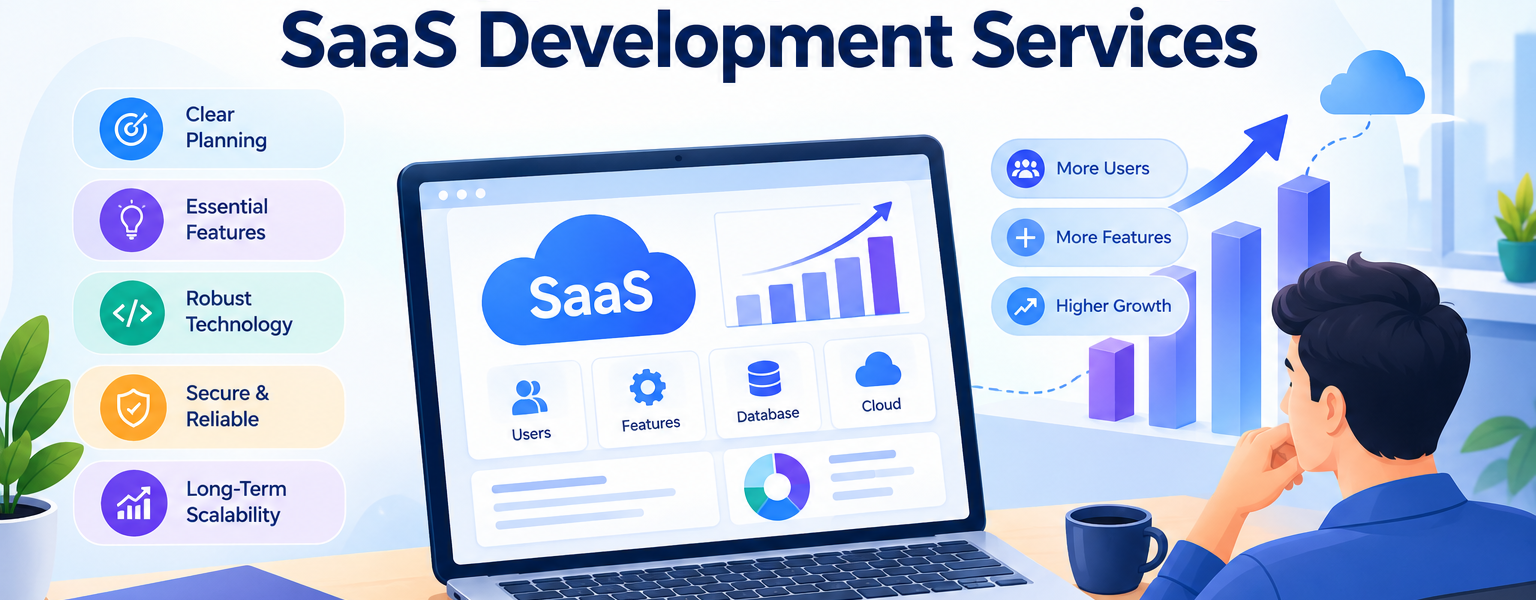
Building Scalable SaaS Products with App Scoop’s Fixed Scope SaaS Development Services

Software as a Service (SaaS) has transformed how businesses deliver digital solutions, manage operations, and serve customers. From subscription-based business applications to cloud-powered management platforms, SaaS products enable organizations to provide accessible, flexible, and efficient services without requiring customers to manage complex software infrastructure themselves. As demand for digital solutions continues to grow, businesses need a reliable approach to developing SaaS products that meet current requirements while supporting future expansion.
Building a successful SaaS application requires more than writing code. It involves understanding customer needs, defining essential features, selecting appropriate technologies, managing development costs, and planning for long-term growth. Without a clear development strategy, projects can face unexpected expenses, unclear requirements, delayed launches, and technical challenges.
Fixed Scope SaaS Development offers a structured approach by defining project requirements, deliverables, timelines, and agreed costs before development begins. This helps businesses establish clear expectations and maintain better control over the development process.
App Scoop, an AI-native software development company, provides services across web app development, mobile app development, AI automation, LLM integration, API integration, and intelligent data processing. By focusing on clearly defined project requirements and appropriate technical planning, businesses can explore development approaches that align with their goals and establish a foundation for scalable SaaS products.
Understanding Fixed Scope SaaS Development
Fixed Scope SaaS Development is a software development approach in which the project’s primary features, technical requirements, deliverables, and agreed budget are established before the main development work begins. The client and development team collaborate to determine what needs to be built and how the agreed requirements will be delivered.
This approach is particularly useful when businesses have a clear understanding of their product idea and can identify the essential features required for the initial release.
Key Elements of Fixed Scope SaaS Development
A properly planned fixed-scope project generally includes several important elements:
- Defined requirements: Clear documentation of the product’s purpose, features, and expected behavior.
- Specific deliverables: A documented list of the software components and functionality included in the project.
- Agreed budget: Development costs based on the approved scope of work.
- Project timeline: Milestones for design, development, testing, and delivery.
- Acceptance criteria: Conditions used to determine whether the completed product meets the agreed requirements.
These elements help establish a common understanding between stakeholders and developers. They also provide a framework for tracking progress and evaluating the completed application.
Why Businesses Choose a Fixed-Scope Approach
Businesses often prefer Fixed Scope SaaS Development when they need predictable project commitments and clear delivery expectations. Rather than allowing requirements to change continuously, the approach encourages stakeholders to identify priorities before implementation begins.
This structure can be particularly valuable for startups and growing companies that need to manage development spending carefully while bringing a new digital product to market.
Why Scalability Matters for SaaS Products
Scalability refers to an application’s ability to handle increasing demand without experiencing unacceptable performance problems or requiring a complete redesign. For SaaS businesses, growth may involve more users, larger datasets, additional integrations, new subscription plans, or expanded functionality.
Planning for scalability early can reduce the difficulty of accommodating these changes later.
Supporting Increasing User Demand
A SaaS application may initially serve a small customer base but attract significantly more users as the business grows. The software should be designed with realistic expectations about concurrent users, database activity, network traffic, and resource consumption.
For example, an online appointment scheduling platform may need to handle more bookings, notifications, and customer accounts as additional businesses adopt the service.
A suitable architecture, efficient database queries, caching where appropriate, and effective infrastructure monitoring can help the platform manage increased demand.
Preparing for New Features and Integrations
Scalable SaaS products must also support functional growth. Businesses may eventually want to introduce advanced reporting, automated workflows, payment options, analytics, or integrations with external platforms.
A maintainable codebase and clearly defined system components can make these improvements easier to implement. Fixed Scope SaaS Development can help establish the initial architecture and deliverables while keeping future development needs in consideration.
1. Define Clear Business Goals and Product Requirements
The foundation of a scalable SaaS product is a clear understanding of what the business wants to achieve. Before choosing technologies or beginning implementation, stakeholders should identify the problem the application will solve and the audience it will serve.
Identify the Target Audience
Understanding potential users helps businesses determine which features deserve priority. Consider the users’ industry, technical experience, operational challenges, and expectations.
For instance, a SaaS platform designed for small retail businesses may require simple inventory tracking, sales reporting, and low-complexity onboarding. An enterprise platform may need advanced permissions, complex integrations, and detailed reporting capabilities.
These differences should influence the project’s initial requirements.
Establish Measurable Objectives
Business goals should guide development decisions. Depending on the product, objectives might include reducing manual work, simplifying customer management, improving operational visibility, or making a specialized service accessible through a subscription model.
Once objectives are clear, the team can identify the features necessary to support them. This prevents unnecessary functionality from expanding the initial scope.
2. Prioritize Essential Features for the Initial Release
A common challenge in SaaS development is attempting to build every planned feature before launching the product. While a long feature list may appear attractive, it can increase development complexity, cost, and delivery time.
A more effective strategy is to focus on the functionality that delivers the greatest value to users.
Develop a Practical Minimum Viable Product
A minimum viable product (MVP) contains enough functionality to solve a specific problem for its intended users. It allows a business to introduce its product, gather feedback, and validate important assumptions without building every possible feature.
For example, a subscription-based project management application might initially include user accounts, task creation, team collaboration, notifications, and basic reporting.
Advanced analytics, sophisticated automation, and specialized integrations can be evaluated for later releases if they are not essential to the initial product.
Document the Agreed Scope
Under Fixed Scope SaaS Development, essential features should be documented in detail. Each feature should have a clear purpose, expected behavior, and appropriate acceptance criteria.
If stakeholders request additional functionality during development, the team can assess its impact on cost, timeline, and technical complexity before approving the change.
This helps maintain focus while allowing businesses to make informed decisions about future enhancements.
3. Select the Right Technology Stack
Technology choices affect the performance, maintainability, security, and scalability of a SaaS product. The best technology stack depends on the application’s requirements, the team’s expertise, integration needs, and anticipated growth.
Evaluate Frontend and Backend Technologies
Frontend technologies determine how users interact with the application, while backend technologies handle business logic, data processing, authentication, and communication with other services.
The selected technologies should support the application’s functionality without introducing unnecessary complexity.
For example, a data-intensive SaaS platform may require an architecture optimized for data processing, while a straightforward business management tool may benefit from a simpler and more maintainable implementation.
Choose an Appropriate Database and Infrastructure
Database selection should reflect data relationships, transaction requirements, query patterns, and expected workloads. Cloud infrastructure should be evaluated based on reliability, cost, security, and operational requirements.
Scalability does not always require a complicated architecture from the beginning. A well-designed application can start with a practical infrastructure setup and evolve as actual usage patterns become clearer.
The goal is to avoid both underplanning for growth and investing prematurely in infrastructure that the business does not yet need.
4. Design a Secure and User-Friendly Experience
A scalable SaaS product must do more than handle technical growth. It should also provide an experience that helps users complete tasks efficiently and trust the service.
Create Intuitive User Journeys
Start by identifying the main tasks users need to perform, such as creating an account, configuring a workspace, managing subscriptions, accessing reports, or inviting team members.
Wireframes and prototypes help stakeholders evaluate navigation, layout, and workflows before development progresses too far.
Early design reviews can identify usability problems while changes are still relatively straightforward.
Build Security Into the Product
Security should be considered throughout development. Appropriate measures may include secure authentication, role-based access control, encrypted data transmission, safe handling of credentials, and regular dependency updates.
SaaS applications that serve multiple organizations must also ensure that one customer’s data cannot be accessed by unauthorized users from another organization.
The appropriate safeguards depend on the application’s purpose, the sensitivity of its data, and applicable legal or industry requirements.
5. Establish Clear Budgets and Development Timelines
Budget and timeline management are important for businesses investing in new SaaS products. Without realistic estimates, projects may encounter financial pressure or miss important business deadlines.
Fixed Scope SaaS Development provides a framework for estimating development costs based on documented requirements and agreed deliverables.
Identify Major Development Expenses
A SaaS development budget may include requirements analysis, interface design, frontend development, backend implementation, integrations, testing, and deployment preparation.
Businesses should also account for ongoing expenses such as hosting, third-party subscriptions, monitoring, maintenance, and customer support. These costs may not be included in the initial development price unless the agreement explicitly states otherwise.
Use Milestones to Track Progress
Divide development into manageable stages with specific deliverables and review points. For example, the project might include requirements approval, design completion, core functionality, integrations, quality assurance, and deployment.
Regular progress reviews help stakeholders identify outstanding work and resolve issues before they affect later stages.
Although a fixed scope improves planning, unexpected technical issues and external dependencies can still affect delivery. Realistic estimates and clear communication remain essential.
6. Integrate APIs and Automation Where They Add Value
Modern SaaS applications often rely on external services to provide payment processing, email notifications, customer management, analytics, and other capabilities. Well-planned integrations can reduce manual work and improve the overall product experience.
Plan Third-Party Integrations Early
Identify required external services before finalizing the scope. Document their expected functionality, authentication requirements, costs, rate limits, and dependencies.
For example, a SaaS subscription platform may need a payment provider, an email delivery service, and an analytics tool. Planning these integrations early helps the team estimate their implementation and testing requirements.
Use Automation Strategically
Automation can simplify repetitive tasks such as notifications, data synchronization, report generation, and workflow management. AI-based capabilities may also help with classification, content processing, or intelligent assistance when they solve a genuine user problem.
However, every additional integration or automated feature introduces implementation, testing, security, and maintenance considerations. Features should be selected according to their business value and included in the approved scope when they are part of the initial deliverables.
7. Make Quality Assurance a Core Development Activity
Software quality directly affects user satisfaction, operational reliability, and the long-term cost of maintaining a SaaS product.
Testing should be planned from the beginning instead of being treated as a final step.
Test Functional Requirements
Quality assurance teams should verify that each feature behaves according to its documented requirements. Testing may cover registration, account permissions, subscription management, reporting, integrations, and error handling.
Integration testing is particularly important when multiple services or application components depend on one another.
Evaluate Performance and Reliability
Performance testing can help determine whether the application handles expected workloads appropriately. Teams should also test critical workflows, monitor errors, and confirm that backup and recovery procedures work as intended.
Security testing should be included according to the product’s risk profile and requirements.
A clearly defined testing process helps businesses evaluate deliverables objectively and identify problems before launch.
8. Establish an Effective Change Management Process
Even when a project begins with detailed requirements, new ideas and unexpected challenges can emerge during development. The key is to evaluate changes systematically instead of allowing them to expand the scope without approval.
Assess the Impact of New Requirements
Every substantial change should be evaluated for its effect on development effort, cost, timeline, architecture, and existing functionality.
For example, adding a new payment model may require changes to subscription logic, billing workflows, database structures, and testing procedures.
The development team should explain these implications so stakeholders can make informed decisions.
Maintain Flexibility Without Losing Control
Fixed Scope SaaS Development is most effective when the initial requirements are reasonably stable. A formal change process provides a way to handle new priorities while maintaining transparency about the original agreement.
Features that are not essential to the current release can be recorded for future development rather than added immediately.
How App Scoop Supports SaaS Product Development
Selecting a development partner is an important decision for businesses planning to launch a SaaS application. The right partner should understand the product’s business objectives, technical requirements, user expectations, and long-term direction.
App Scoop is an AI-native software development company offering web app development, mobile app development, AI automation, LLM integration, API integration, and intelligent data processing services.
For businesses exploring Fixed Scope SaaS Development, App Scoop can be considered for discussions about defining project requirements, prioritizing features, evaluating technology choices, and planning the implementation process.
Aligning Technical Solutions With Business Needs
A successful development engagement starts with a clear understanding of the product idea, intended audience, required functionality, budget, and expected timeline.
These details help establish realistic deliverables and identify technical dependencies before implementation begins.
Businesses should also discuss scalability requirements, testing responsibilities, deployment arrangements, maintenance expectations, and post-launch support to understand the complete scope of the engagement.
Building a Foundation for Future Expansion
Scalability should be treated as a practical design consideration rather than a promise of unlimited growth. By selecting appropriate technologies, maintaining clear technical documentation, and planning for expected workloads, businesses can make future enhancements easier to manage.
App Scoop’s range of software and AI-related services may be relevant to organizations that need web-based platforms, integrations, or intelligent automation as part of their SaaS product strategy.
The specific approach should always depend on the business’s requirements, the complexity of the product, and the agreed project deliverables.
Conclusion
Building a scalable SaaS product requires a thoughtful combination of business planning, technical design, feature prioritization, quality assurance, and long-term operational preparation. Businesses must understand their target audience, define essential functionality, choose suitable technologies, and establish realistic expectations before development begins.
Fixed Scope SaaS Development provides a structured framework for managing these activities by defining project requirements, deliverables, timelines, and agreed costs in advance. It can help businesses maintain better visibility into development progress, reduce scope-related uncertainty, and focus resources on the features that matter most.
However, scalability also depends on maintainable architecture, appropriate security controls, reliable integrations, performance monitoring, and ongoing improvements after launch. A clear change management process allows businesses to respond to evolving needs without losing sight of their original objectives.
With careful planning and a suitable development partner, businesses can create SaaS products that serve current users effectively while establishing a practical foundation for future growth. App Scoop can be considered by organizations looking to explore software development and integration solutions aligned with their SaaS goals.


![How to fix outlook [pii_email_6a61216eeba5eea68c5f] error](https://epaperplanes.com/wp-content/uploads/2021/08/8c5f.png)